☎ Water where it should not be? Talk it through with a local Arvada plumber at (303) 552-3896.
The Frost-Free Irony
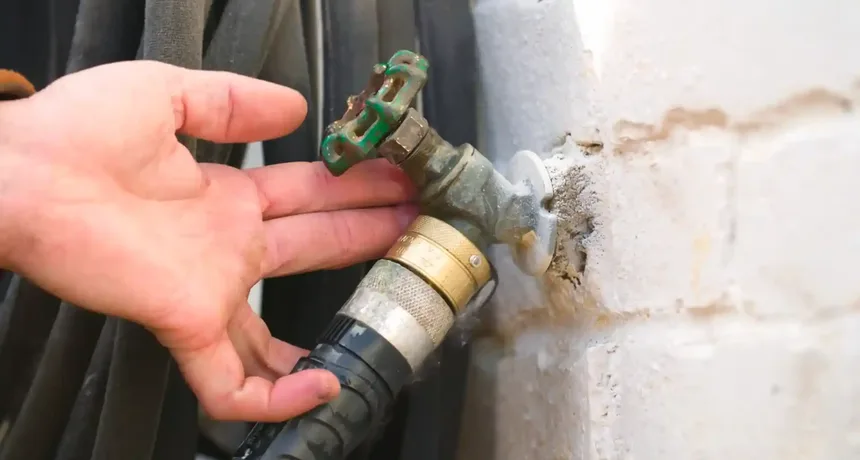
A frost-free hose bib is the smart design: a long stem sets the shutoff seal a foot back inside the warm wall, and the outer barrel empties itself after every use. It fails ironically. Leave a hose attached over winter and water stays trapped in the barrel. That the trapped water freezes, and the pipe splits at the stem's inner tip, back within the wall cavity. Inside the wall, what was a warm-side benefit turns into concealed harm.
The bib runs fine all winter, since the crack only lets go once the valve opens and puts the barrel under pressure. That is exactly what happens the first warm day you connect a hose. Water runs behind the siding into the rim joist. The anatomy is on our hose bib page.
The 30-Second Spring Test
Before trusting any bib in spring, test it: open the valve while capping the outlet with your thumb, or with a plugged hose, and keep the pressure on. A good bib pushes back steadily against your thumb. A cracked barrel leaks pressure past your thumb straight into the wall, and the failure stands revealed with no stain required.
Then look inside: inspect the ceiling or the joist bay behind each bib once spring's first use is done. Any dampness in that bay gives it away, and confirming it with instruments right through the intact wall is quick, the same read-through-the-surface method on our wall leak page. The mixed bib populations around Berkley Estates, part original, part retrofit, make this test especially worth the thirty seconds.
Why Insulation Alone Is Not Enough
Foam covers help standard bibs and cost pocket change, but they only slow heat loss; they do not generate warmth. During a prolonged cold snap or against a supply pipe running through an uninsulated wall cavity, a covered bib can still freeze where the pipe actually lives, behind the wall, out of the cover's reach.
The reliable defense combines the cover with the real move: disconnect the hose. That one habit heads off the frost-free trap entirely, since the barrel clears only with its outlet open to air.
Catch the Confession Early
Water in the basement when you use the front bib is the classic split-barrel confession, and the harm scales with how long you wait, not with the crack itself. Found at the first spring use, it is a small fix. Left leaking through a summer of waterings, it grows into a framing project.
Take the suspect bib out of service, have the barrel swapped and the cavity dried, and fold the whole exterior into an autumn shutdown next year. A single autumn afternoon, or a call to (303) 552-3896 for an exterior shutdown, purchases an uneventful spring.
Hose Bib Questions From Arvada
My hose bib sprays from the handle, not the wall. Same problem?
Probably not. Handle spray is usually the packing, a cheap stem seal that often just needs tightening or replacement. A freeze split speaks differently: pressure slipping past your thumb, spray near the barrel, or wall dampness. Each deserves repair, though only one is pressing.
Do frost-free bibs really need winterizing?
They need just one habit honored: nothing hooked up when the cold arrives. It clears its own barrel only while the spout stands open to air. A splitter or quick-connect left in place holds water nearly as well as a hose would, and the barrel is what suffers.
Water shows up in my basement when I use the front spigot. How bad?
That is the textbook split-barrel giveaway. Take the bib out of service, then have the barrel swapped and the cavity dried without delay. Caught at first spring use it is modest; left running all summer it becomes a framing job. The damage scales with waiting, not with the crack.